Urban Vehicle Access Regulations (UVARS) - A PIARC Case Studies Collection
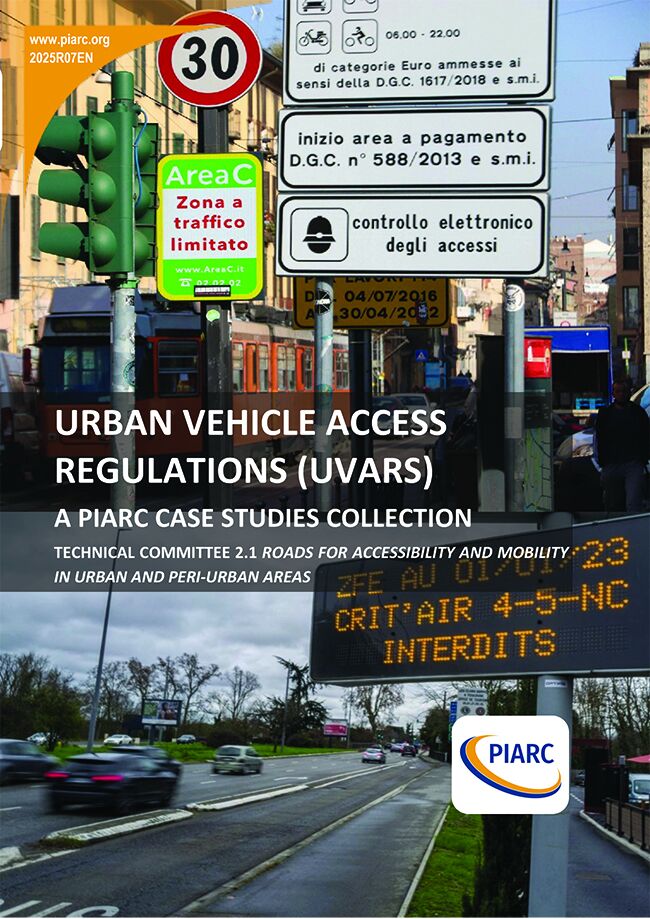
This report presents a global collection of case studies on Urban Vehicle Access Regulations (UVARs), compiled by the Technical Committee 2.1 “Roads for Accessibility and Mobility in Urban and Peri-Urban Areas” of the World Road Association (PIARC). It is one of the three deliverables from Working Group 2.1.2, which specifically focuses on UVARs for the 2024–2027 Strategic Plan cycle. The two other deliverables are the literature master list and the briefing note.
Urban areas face increasing challenges linked to traffic congestion, air and noise pollution, road safety, and the adequate use of public space. In response, UVARs have emerged worldwide as strategic tools to manage and regulate vehicle access to urban areas. These measures aim to reduce negative impact of motorized traffic by applying geographical restrictions based on vehicle type, emissions, time of access, or user category.
The objective of this report is to document and disseminate a broad range of UVAR schemes implemented across different cities and regions. The case studies collected here reflect diverse regulatory approaches and urban contexts, including middle- and low-income countries. It provides insight into the impacts, benefits, implementation processes, and the challenges faced—thus serving as practical examples for policymakers, practitioners, and researchers.
The scope of this report is limited to descriptive and analytical presentations of case studies. It does not contain normative conclusions or policy recommendations. These will be addressed in a subsequent PIARC publication in the form of a Briefing Note, which will synthesize findings and propose guidance for cities considering UVARs.
The report is structured as follows:
•Chapter 1: Introduction – Contextualises urban mobility challenges and the rationale for UVARs.
•Chapter 2: Definition and Typology of UVARs – Establishes a conceptual framework and categorises UVAR models.
•Chapter 3: Methodology – Outlines the approach used to collect and analyse the case studies.
•Chapter 4: Results of Multimodal Good Practice Collection – Presents detailed results of UVAR collection worldwide.
•Chapter 5: Case Studies – Presents detailed examples of UVAR implementation worldwide, following a standardised fact sheet template.
•Chapter 6: Conclusion and Next Steps – Summarises key observations and outlines the future work of the Briefing note
This work contributes to PIARC’s broader mission of supporting sustainable and inclusive road policies by addressing the relationship between mobility, environmental health, and spatial justice in urban and peri-urban environments.
Information sheet
- Date: 2025
- Author(s): Comité technique / Technical Committee / Comité Técnico 2.1 Mobilité dans les zones urbaines / Mobility in Urban Areas / Movilidad en zonas urbanas
- Domain(s): Urban Mobility
- Type: 2025R07EN - A PIARC Case Studies Collection
- PIARC Ref.: 2025R07EN
- ISBN: 978-2-84060-445-5
- Number of pages: 95